January, April, July, October
See Key Dates
The Bachelor of Business with a major in International Business prepares students to thrive in the global marketplace by equipping them with the skills, knowledge, and strategic mindset required to navigate cross-border business environments. After establishing a comprehensive foundation in core business areas during the first year, students undertaking this major delve into the complexities of international commerce, developing a nuanced understanding of how global markets, cultures, and institutions interact. In the second year, students begin to explore leadership in diverse cultural contexts, global economic dynamics, and the impact of digital technologies on international business activities.
The Bachelor of Business with a major in International Business equips graduates to work across borders, manage international operations, and understand the dynamics of global markets. They gain intercultural competence, global strategic thinking, and digital business insights—key attributes for today’s internationally focused organisations. Possible career outcomes include:
Students wishing to gain entry to an ASA Institute of Higher Education undergraduate course must meet at least one of the following entry criteria.
Admissions Criteria
English Language Requirements
Along with the above admissions criteria, international applicants also must demonstrate and meet one of the following minimum English Language Proficiency standards:

For more information and country specific English exemptions please see Section 8. English Language Requirements of the Student Admission Policy.
International Students must apply through a qualified Education Agent. For more information visit why we use an agent.
International applicants are only eligible to enrol as full-time student and must be 18 years of age or over at the time that they commence the course for which they have applied.
Any student with prior learning may submit appropriate evidence and apply for Recognition of Prior Learning. ASA may award credit towards achievement of a qualification or award for various forms of prior learning by comparing a student’s current level of skills and knowledge against unit learning outcomes.
ASA may, at its discretion, recognise the validity of other forms of training or education, providing they are deemed equivalent to, or meet, the AQF standards. For further information please review the Recognition to Prior Learning Policy.
ASA Tuition fees are charged on a 'per unit of study' basis. The number of units of study are specified within the Letter of Offer provided to each student*.
Students must pay their fees for each study period in advance and in accordance with their LoO which provides admission to the course. The LoO indicates all due dates for fee payments during the course enrolment.
*If you have/plan to apply for Recognition of Prior Learning, the total number of units of study is subject to change.
All other fees associated with studying at ASA are non-tuition fee related and will only be charged dependent on the individual student circumstances, these include but are not limited to:
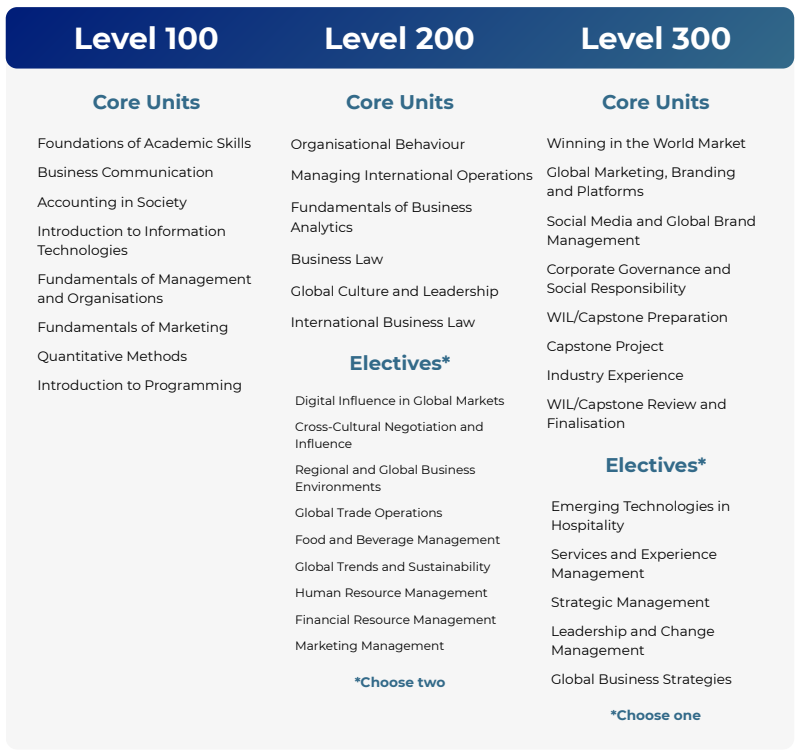
The Bachelor of Business major in International Business comprises twenty-three (23) units of core, major and elective units over 100, 200 and 300 levels to meet the requirements of with the Australian Qualifications Framework (Level 7), and Higher Education Standards Framework.
This course commences with eight (8) core units at the 100 level that provide students with a strong grounding in the knowledge, skills to move to the next level. Within the 200 level there are three (3) core units, three (3) major units and two (2) electives. At the final 300 level, there are one (1) core unit, three (3) major units, two (2) elective units and one (1) capstone unit at the 300 level.